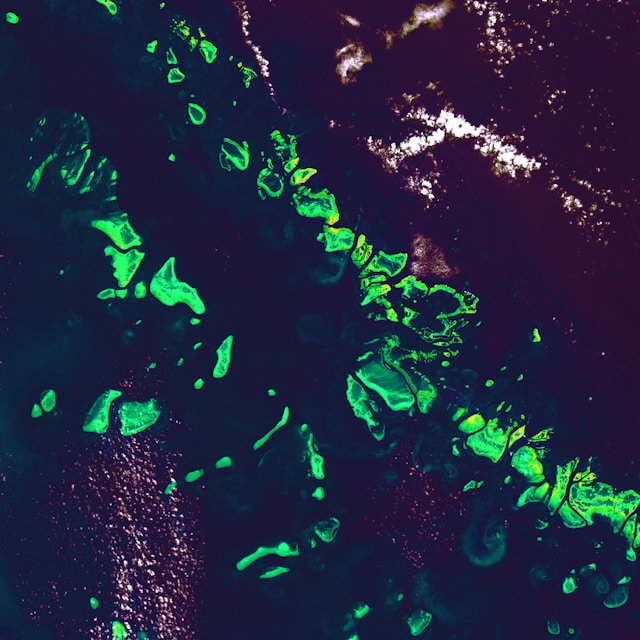
Sea surface temperatures in waters surrounding the Great Barrier Reef this year reached their warmest levels in more than 400 years, new research has found.
The findings of the long-term study suggest human-caused climate change is the driving factor behind increasingly high summer temperatures in the Coral Sea, which puts corals under stress and can spur mass bleaching.
Researchers warn the findings show the Great Barrier Reef is being pushed closer to a tipping point from which it may not recover, and that urgent action is needed to limit the global temperature rise to a maximum of 1.5 degrees Celsius.
Coral ‘like tree rings’
The research, published in the journal Nature, reconstructed historic sea temperature data dating back as far as the year 1618.That data was obtained by drilling into the cores of coral colonies and analysing their structure.
“They form bands, they change in density, and they’re a bit like tree rings that we can count,” said Professor Helen McGregor, a geologist and climate change researcher at the University of Wollongong.
Professor McGregor said the ocean temperatures were ascertained using fine-scale measurements to look at changes in the amount of strontium relative to calcium in the coral skeleton, along with changes in oxygen isotopes.
Using that data and instrument recordings dating back to 1900, the researchers ranked sea surface temperatures in the Coral Sea by year from warmest to coolest.They found the period from January to March 2024 was the warmest in more than four centuries, followed by the summers of 2017, 2020, 2016, 2004, and 2022.
“It’s head and shoulders above even the latest record in 2017 for the Coral Sea,” said lead author Dr Benjamin Henley of the severity of the 2024 temperature.
Dr Henley said the findings were not only scientifically significant but “of great sadness” as they reveal the world is in danger of losing one of its most spectacular natural wonders, the Great Barrier Reef.”I find that to be an absolute tragedy,” the University of Melbourne lecturer said.
“It’s hard to understand how that can happen on our watch in our lifetime.”
It is the first time researchers have been able to compare recent warm summers to those dating back centuries, and Dr Henley said the warm years over the past decade were “very extreme in that longer-term context”.