

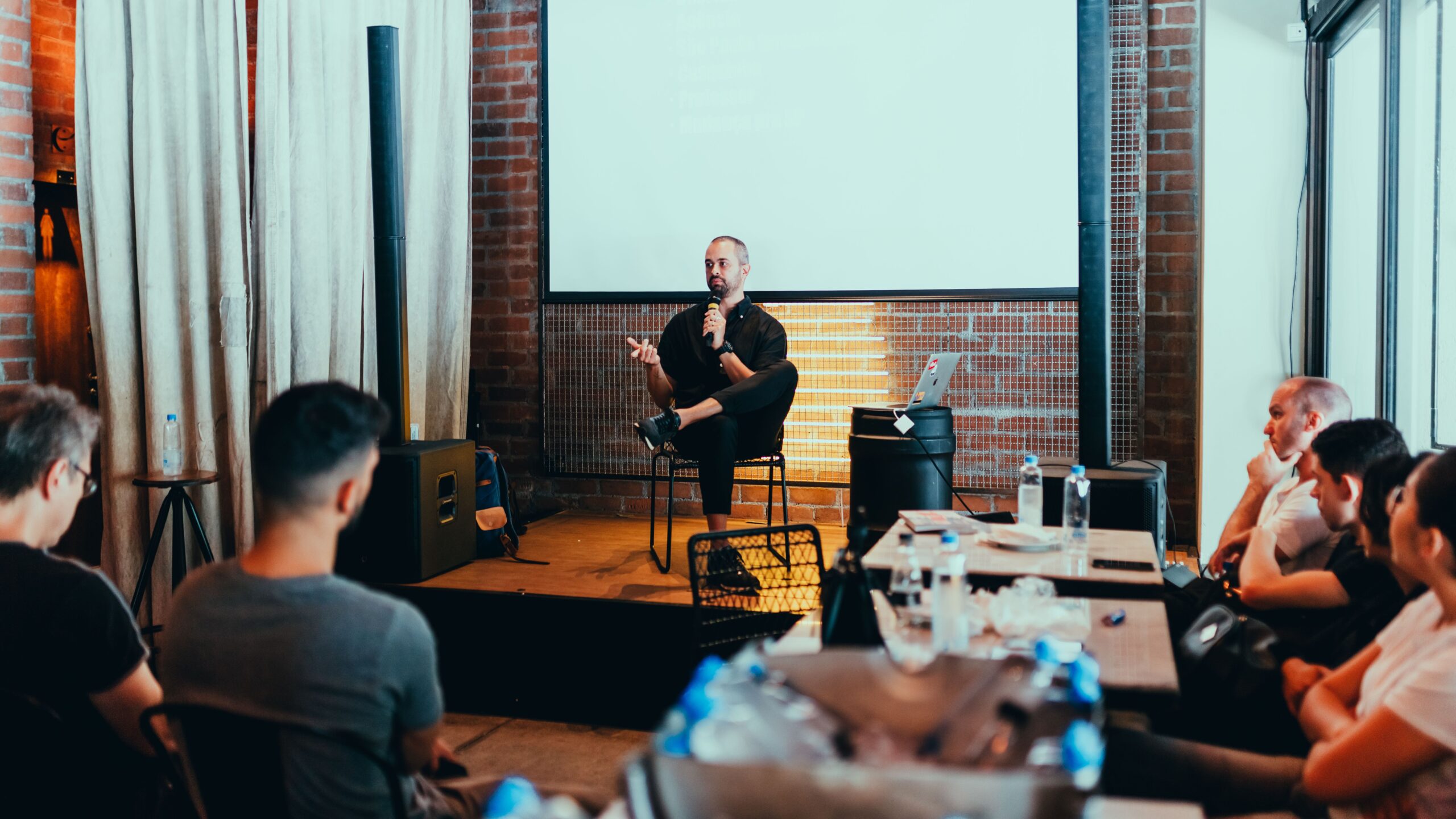
Every industry has people who know their craft. Far fewer know how to turn decades of experience into a keynote that genuinely captures a room.
Australia’s leading keynote speakers come from remarkably different backgrounds, but they share one thing in common: they’ve built careers worth learning from. Whether they’re talking about leadership, business growth, technology, resilience, or high performance, they bring hard-earned insights that resonate with audiences looking for more than feel-good inspiration.
Here are some of the keynote speakers helping shape business conversations across Australia today.
Ben Popplestone

Ben Popplestone has learned as much about leadership on mountain ridgelines, at sea and deep into ultra marathons as he has in any boardroom, environments where the margin between good judgement and poor decisions is impossible to ignore.
Popplestone spent 25 years leading high-growth technology businesses across the UK and Australia, including as Director of Adobe Commerce APAC after overseeing one of Australia’s largest Magento agencies. During that time, he helped scale a platform business to US$50 million while leading teams through rapid growth, transformation and constant uncertainty. In parallel, his lifelong pursuit of mountaineering, ocean sailing, diving and endurance sports became an equally important source of insight into resilience, decision-making and leadership under pressure.
Those two worlds now come together through Adventure Mentors, the leadership consultancy he founded after stepping away from corporate life in 2025. His keynote presentations introduce audiences to the Adventure Mindset and Guide Mentality, frameworks shaped by real commercial experience and genuine adventure rather than metaphor alone. Drawing on stories where the consequences of a decision were immediate and tangible, Popplestone explores how purpose, trust and adaptability help teams perform in fast-changing environments without sacrificing wellbeing.
Adventure Mentors extends those ideas through leadership programs and workshops that help organisations navigate growth, disruption and uncertainty. Rather than promoting resilience as simply pushing harder, Popplestone encourages leaders to think more deliberately about how they build cultures where people remain engaged, capable and willing to tackle the next challenge together.
Esther De La Cruz

Even the strongest strategy can unravel if leaders fail to create the conditions that enable people to succeed.
After more than 25 years partnering with executive leaders through complex operating model, technology, cultural and organisational transformations, Esther De La Cruz has come to believe that transformation rarely fails because the strategy is flawed. More often, it stalls because leaders overlook the human conditions that make successful execution possible.
As a Strategic Transformation Advisor and keynote speaker, De La Cruz has worked across Australia, Europe, Asia and the Caribbean, helping organisations navigate change in industries including financial services, hospitality, healthcare, government, energy and consumer goods. Her work combines strategic advisory, executive coaching and facilitation to help leadership teams create clarity, alignment and momentum during periods of significant change and uncertainty.
At the heart of her approach is a simple belief: leaders don’t create or implement transformation; they create the conditions in which transformation becomes possible. Through her emerging leadership framework, she helps executives strengthen the conditions that create clarity, context, collaboration and confidence, building the momentum needed to deliver lasting commercial outcomes.
As organisations navigate the accelerating impact of AI, shifting market conditions and increasing organisational complexity, De La Cruz is helping reshape the leadership conversation around transformation, not as a programme to manage, but as a leadership capability that allows both people and performance to thrive.
Nadir Khan

Every organisation talks about change, but few stop to ask whether their people, culture and systems are ready for it. That question defines Nadir Khan’s work as a keynote speaker, entrepreneur and founder of organisational transformation consultancy Agilitie.
Across transformation programs at some of Australia’s largest organisations, including Australia Post, Telstra, Myer and ME Bank, Khan saw the same pattern: well-designed strategies struggled when the conditions for change weren’t in place. That insight shaped Agilitie, and later his book, “The Goldilocks Zone: How Leaders Build the Conditions for Continuous Evolution,” co-authored with Craig Kimball. Released in July 2026, it reached #1 Best Seller and #1 Hot New Release in its opening week. The book argues that sustainable transformation depends less on the strategy itself than on the organisational climate where change can take root.
As a keynote speaker, Khan draws on real-world experience rather than management theory, exploring why change stalls and how leaders shape the climate that lets a culture keep evolving. He holds a Master’s in Software Engineering, with further qualifications in behavioural psychology, systems thinking and complexity theory.
The same thinking guides Agilitie’s consulting, favouring co-designed approaches over standardised methodologies, and client capability over dependence. Khan is also a serial entrepreneur with an AI venture in development, and founded AASMA, connecting Australian women leaders with aspiring female professionals in Pakistan.
Whether speaking to executive teams or advising organisations through complex change, Khan makes a compelling case that successful transformation is rarely about the perfect strategy. More often, it’s about creating the conditions that allow good ideas to succeed long after the consultants have left.
Emma Weber

Artificial intelligence is moving faster than most people and organisations can keep up with. And the mistake, says Emma Weber, is treating it as a technology rollout. She’s spent more than two decades studying why and how people change, and AI has made a particular question more urgent than ever: what does it mean to stay human as technology reshapes how we work?
Long before generative AI entered everyday conversation, Weber was already exploring its potential. She developed one of the world’s first AI coaches in 2017 and has since become a recognised voice on the relationship between technology, leadership and human behaviour. As the author of “Turning Learning into Action” and a regular international conference speaker, she argues that real transformation depends on whether people genuinely change the way they think, lead and make decisions.
That philosophy defines her practice, Being Human in the Age of AI. Rather than giving people access to AI and hoping for the best, Weber works with leaders on the cultural and behavioural shifts that accompany technological change.
At the centre of Weber’s work is a belief that AI should expand human capability, not diminish it. As AI enters organisations, human qualities such as judgement, curiosity and empathy become more valuable than ever. But naming them, she argues, isn’t enough. Leadership programmes have tried to develop these qualities for years and largely failed. Weber’s work goes deeper, helping people rebuild the human foundation those skills grow from. That, she says, is what real transformation asks of us.
Ashok Alexander

There are moments in life that divide everything into a before and an after. For Ashok Alexander, that moment was losing the business that had quietly become his identity. That led to a search to understand who he was without the title he’d spent years building.
That search took him 4,032 kilometres across Australia, walking alone for months with little more than time, silence and the road ahead. Along the way, Alexander immersed himself in breathwork, meditation, yoga, somatic practices and coaching, discovering that the answers he was looking for couldn’t be found by thinking harder; they had to be experienced.
Today, those experiences shape his work as a keynote speaker and founder of Reclaim Self. His presentations move beyond the familiar language of resilience and high performance, inviting audiences to explore the relationship between identity, purpose and leadership. Rather than encouraging people to become someone new, Alexander asks a different question: what parts of ourselves have we left behind while chasing success?
That same philosophy underpins Reclaim Self, where coaching combines mindfulness, breathwork, self-enquiry and evidence-informed practices to help people reconnect with themselves before making decisions about what comes next. The focus isn’t on fixing people or prescribing another framework, but on creating the space for greater clarity, authenticity and intention.
Whether speaking to business leaders, entrepreneurs or individuals navigating major life transitions, or joining one of his Meditation Classes. Alexander’s message remains quietly consistent: meaningful change doesn’t begin with what you do next. It begins with understanding who is making that decision in the first place.
Joanna Zhang

Founders don’t usually set out to become bottlenecks. It happens gradually, as every decision, approval, and operational problem finds its way back to the same person. Joanna Zhang is helping business owners break that cycle.
As founder and CEO of The Operations Genius, Zhan works with growing businesses to rethink how they operate so founders can spend less time managing day-to-day tasks and more time leading strategically. Her experience sits at the intersection of operations, leadership and business growth, with a focus on creating systems that are resilient enough to support expansion without becoming overly reliant on any one individual.
That philosophy shapes her keynote presentations, where she challenges audiences to reconsider what operational success really looks like. Rather than equating growth with working longer hours, Zhang explores how thoughtful systems, emerging technologies and stronger leadership can create businesses that are both more productive and more sustainable. Her talks focus on practical strategies that help founders move from operator to leader while building organisations capable of thriving without constant intervention.
Those same principles underpin The Operations Genius. Best known for introducing what it describes as the world’s first Fractional VA service, the business combines operational strategy, flexible specialist support, AI-enabled workflows and access to experienced advisors across multiple business functions. The emphasis is on helping organisations build internal capability and stronger ways of working.
As conversations around leadership increasingly shift toward sustainability and resilience, Zhang’s work suggests that the strongest businesses are often those designed to give founders something many struggle to find: the freedom to step back without everything falling apart.
Carol Cooke AM PLY

Some people spend a lifetime preparing for a defining moment. Carol Cooke AM PLY has reinvented herself through several of them. From serving as Police Officer in Canada for 14 years, with 4 of those years working undercover, to becoming a Paralympic gold medallist in Australia after being diagnosed with Multiple Sclerosis, her career has been shaped by an ability to adapt when life takes an unexpected turn.
Cooke’s achievements in elite sport are remarkable in their own right. After initially competing in swimming and rowing, she went on to win three Paralympic gold medals in cycling, a silver medal at the Tokyo Paralympics at the age of 60, and multiple world titles. Beyond competition, she founded the 24-Hour Mega Swim, which has raised more than $11 million for Multiple Sclerosis research and support, and was appointed a Member of the Order of Australia in recognition of her contribution to sport and advocacy.
Today, Cooke brings those experiences to audiences through keynotes that explore resilience, leadership and navigating change under pressure. Her presentations examine how individuals and teams respond when uncertainty, setbacks, or exhaustion threaten progress. Drawing on lessons from policing, elite sport and advocacy, she shares practical frameworks that encourage people to build confidence, strengthen adaptability and move from hesitation to action.
Her speaking work also extends into workshops for corporate teams, schools and leadership groups, with sessions covering resilience, goal setting and high-performance mindsets. Throughout it all, Cooke returns to a consistent message: extraordinary outcomes come from learning how to keep moving forward, one decision at a time.
Deb Doyle

Do you mistake clear written communication for natural talent? Deb Doyle has spent more than three decades proving it’s a learnable skill.
A freelance book editor since 1989, Deb works with not only self-publishers and authors who are on the traditional-publishing path but businesspeople and professionals, guaranteeing that the meaning of any text they produce is clear and unambiguous. Since 1995, she’s been teaching grammar, editing and professional writing, both privately and publicly, including at Sydney University’s Centre for Continuing Education, Writing NSW and WEA Sydney. Radio presenters regularly invite her to share her ‘language and literacy’ expertise with their listeners and to advocate for stronger communication standards among Australians.
As a keynote speaker, Deb brings that same passion to the stage. She challenges the common assumption that grammar is merely about rules, instead arguing that effective communication begins with respecting the reader or listener. Combining humour, practical examples and decades of teaching experience, she explores how we can use language to shape our credibility, influence how we’re understood and strengthen our professional relationships, regardless of what industry we’re in.
As both a sought-after copy editor and a popular educator, she extends her philosophy beyond the keynote. Via manuscript editing, one-on-one tuition, corporate training and her ‘Grey Areas and Gremlins’ text-workbook and supplementary course notes, Deb helps all manner of writers develop the necessary skills for communicating clearly and confidently. She doesn’t focus on perfection for its own sake; she makes complex ideas easier for everyone to understand.
Kirsten Taylor-Martin

For many family businesses, the hardest conversations are about what happens next, not about profits or growth. Succession, governance and legacy can be deeply personal topics, yet they’re often treated as purely commercial decisions. Kirsten Taylor-Martin has built her career helping families navigate both sides of that equation.
Drawing on a background in taxation and accounting, Taylor-Martin specialises in advising multi-generational family businesses and family offices on governance, succession planning and long-term wealth stewardship. As a Fellow of the Family Firm Institute and an Accredited Specialist Advisor with the Family Business Association, she works with families facing some of their most significant decisions, helping them balance technical, financial and interpersonal complexities with equal care.
That perspective also shapes her keynote presentations. Rather than focusing solely on business continuity, Taylor-Martin explores the human dynamics that determine whether family enterprises successfully transition from one generation to the next. She challenges leaders to think beyond legal structures and succession plans, examining how communication, trust and financial capability influence the longevity of both businesses and family relationships.
The same philosophy underpins her advisory work, including the Rising Gen Financial Acumen program, which equips future leaders with the confidence and understanding needed to step into greater responsibility. By combining practical governance expertise with a long-term view of family dynamics, Taylor-Martin helps families build stronger foundations for the future.
Luke Irwin

Most people don’t think about cybersecurity until something goes wrong. Luke Irwin has built his career helping leaders change that mindset, arguing that cyber risk is no longer just an IT issue but a business leadership challenge that affects everything from reputation and customer trust to operational resilience.
As founder of Aegis Cybersecurity, Irwin brings around 25 years of experience spanning cybersecurity, enterprise technology, governance and organisational resilience. His career has included responsibility for large-scale technology environments supporting thousands of sites and hundreds of thousands of users, alongside advisory work with boards, executives and business owners navigating increasingly complex digital risks.
That experience shapes both his consulting work and his keynote presentations. Rather than overwhelming audiences with technical jargon or worst-case scenarios, Irwin focuses on helping non-technical leaders understand the commercial realities of cybersecurity. His talks explore topics such as executive accountability, cyber governance, business continuity, incident preparedness and the human behaviours that often determine whether organisations withstand or succumb to cyber threats.
The same practical philosophy underpins Aegis Cybersecurity. The independent advisory firm works with small and medium-sized businesses, professional services firms and organisations operating in regulated industries, providing strategic guidance across cyber governance, risk management, business continuity, incident response planning and security frameworks. Rather than simply identifying technical vulnerabilities, the business helps organisations build stronger decision-making processes and long-term resilience.
As cyber incidents become an increasingly common boardroom issue, Irwin’s message is consistent: cybersecurity is ultimately about leadership, preparedness and making informed decisions long before a crisis occurs.
Disclaimer: The content in this article is provided for general informational purposes only and reflects publicly available or contributor-supplied information about the featured speakers. This is a paid branded content feature, and some or all of the profiles included were created in collaboration with the individuals or organisations featured. The list is not ranked, is not exhaustive, and does not constitute an endorsement or independent assessment of any speaker, their services, or their fees. Readers should make their own enquiries before engaging any speaker or agency.


