

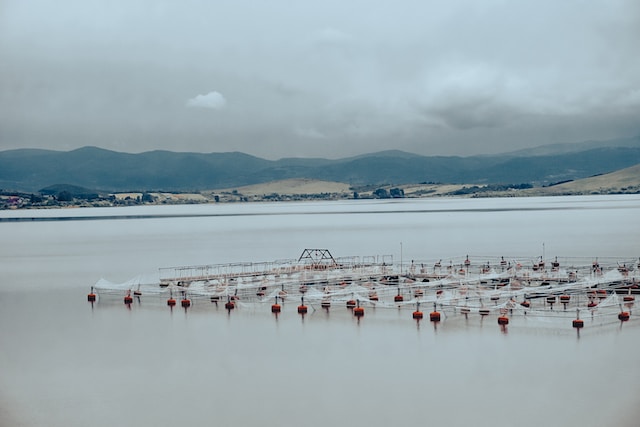
Scientists fear a marine heatwave on the New South Wales south coast this summer could have grave consequences for sea life and the aquaculture industry.
Marine heatwaves are prolonged periods of extremely warm ocean temperatures, which in the past have contributed to the loss of kelp forest, abalone, and oysters.
The current system is sitting offshore, and there are concerns if it swings onshore, history may repeat itself.
The CSIRO has predicted warming of the ocean by 1 to 2.5 degrees Celsius for the south-east Australian coast, already known as a global warming hotspot.
Research fellow from the University of Tasmania Cayne Layton, who lives on the far south coast of NSW, likens the warming to a land-based hot spell.
“We obviously have general warming on land, but we also get this period of intense, often short warming … it’s really the same thing in the ocean,” he said.
Dr Layton has previously seen the grim loss of 95 per cent of giant kelp forest in Tasmania, due to warmer waters and climate change.
He said golden kelp forests were home to “incredible species”.
“It’s the most abundant and arguably the most important kelp in this part of the world,” he said.
“In 2010-2011 we saw a really extreme marine heatwave in WA and that caused a 100km die-off of kelp, and 13 years after it still hasn’t recovered.”
‘Window into the future’
Both the south-east of NSW and east coast of Tasmania are known global warming hotspots and both areas are experiencing marine heatwave conditions.
“We’ve already seen upwards of a degree of warming in our oceans in south-east Australia. That’s something forecast globally to happen in the coming decade,” Dr Layton said.
“There’s a lot of attention on our region. It’s a window into the future.”
The NSW government has a response plan for the marine heatwave for the south coast and other areas of the state.
“There’s this ever-narrowing envelope that these species are able to survive in, [as] there are no land masses south of Tasmania,” Dr Coleman said.
“Their range and temperatures are constantly getting smaller, almost pushing them off the Australian continent.
“Some of the predictions are that we’re going to lose a lot of our colder water species, looking 100 years into the future.”
National approach
The NSW DPI is part of a nation-wide response plan to monitor changes.
Scientists have recently tagged and taken samples of golden kelp forest off Eden and Batemans Bay, before the heatwave swings onshore.
Dr Coleman said the research was important.


