

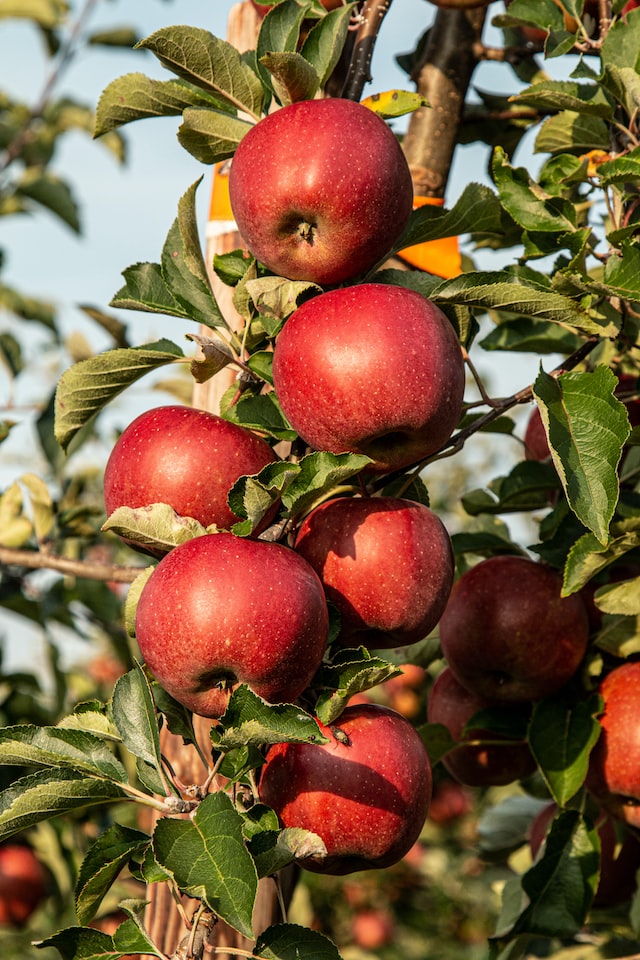
On Boronia Farm, just outside Donnybrook in Western Australia, stands an 80-something-year-old apple tree (Malus domestica) that’s at the heart of a global industry.
This tree produced an apple no one had seen or tasted before, now called the Lady Williams. Without the Lady Williams, there could be no Sundowner, no Pink Lady, no Bravo — apple varieties that, along with the Lady Williams, have made a enormous contribution to the global apple industry.
Boronia Farm’s apple tree is now listed in the register of the National Trust, but the woman behind the Lady Williams is not well known. Yet, as her son Bob remembered, Maud Williams was crucial to the story of this tree and the apple it produced.
A remarkable chance seedling
From the 1930s, Maud, her husband Arthur and their two boys Bob and Ron worked their 12 acres of orchard, with its apples and stone fruit, and 40 cows.
Maud collected ideas for plants to grow, from catalogues and women’s magazines, experimenting with her taste for the unusual, remembers her son Ron. Not content with roses and petunias, Maud was instead growing feijoas and hydrangeas.
With her eye for horticultural novelty, it was perhaps not surprising that she identified the very special qualities of the tree with the bright red apples that had sprung up unexpectedly next to the tank stand beside the house.
The fruit was firm and crisp and showed great suitability for long storage, ideal for Australia’s export market. The Williams family gathered a good price for their cases of apples grown from this tree and over time, the family propagated new trees from the original one.
This tree was a chance seedling, a spontaneous creation whose likely parent cultivars were Granny Smith and Rokewood.
Some of our most common apple varieties began as chance seedlings. But chance seedlings do not reach our supermarkets as a matter of course.
Apples frequently produce chance seedlings. But for a chance seedling to be put into production and become known as a variety, many factors are involved, not least people who recognise distinctive apples that will have value in their contemporary context.
Only a select few chance seedlings are ever turned into varieties with impact in the orchard industry. For that to happen, there need to be people who make the necessary investment of care, time or funding — just as Maud did.
In its inconvenient location, the unfamiliar apple tree was almost cut down many a time, but it survived thanks to Maud’s protection and care. On one occasion when he almost destroyed it, Bob recalled getting a severe telling-off from his mum, who “stood it up again, bandaged it up and it took off again”.
Reflecting Maud’s importance in the creation of this new variety, the apple was given the name Lady Williams. This was the name that the little girl, Lynette Green, who lived on a neighbouring farm, used for Maud.
Maud’s recognition of the qualities of the fruit from this tree, and her initiatives to protect it, were about to enable a remarkable new phase of the Australian apple industry.Lady Williams apples were introduced commercially in 1968, the same year Maud died. By the early 1970s, the Lady Williams was the subject of attention at the WA Department of Agriculture and its new apple-breeding program. There, a team led by the horticulturalist John Cripps was experimenting with combinations of Lady Williams and Golden Delicious.
In an interview conducted as part of the Apples and Pears Oral History Project in 2010, Cripps reflected that the cross-breeding process involved intensive manual labour, high degrees of dexterity and immense patience, a set of qualities Cripps identified in women technicians.
In 1984, one of the over 100,000 experimental seedlings produced an attractive fruit; it was bright pink, crisp, flavoursome and long-storing. Cripps had a hand in both its names: the Cripps Pink, and its commercial name, Pink Lady®. It was the first apple variety ever to be trademarked.
From the same breeding program emerged the Sundowner® and more recently, in 1992, the Bravo®.
All the world’s Lady Williams, Pink Lady, Sundowner and Bravo trees share DNA with the original tree Maud Williams had nurtured many years before.
Writing women’s agricultural contributions
Women’s contributions to the agricultural sector have often occurred, just as Maud’s did, outside of professional roles. They do not always fit easily in conventional profiles for innovation and entrepreneurship in agriculture, nor into standard narratives of Australia’s agricultural development.


