

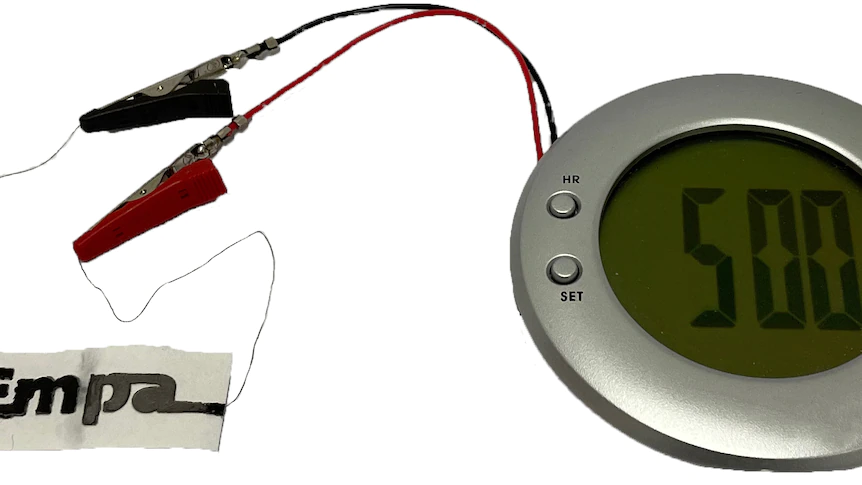
Scientists have developed a battery made mostly from paper and activated by water that they think can help clean up the disposable battery waste stream.
Though only at proof-of-concept stage, the paper-based battery was able to power the digital display of an alarm clock, according to research published today in Scientific Reports.
The battery was able to achieve a maximum stable voltage of 1.2 volts, compared to a standard AA battery’s 1.5 volts, the researchers from the Swiss Federal Laboratories for Materials Science and Technology said.
They think a refined version of the battery could be used in applications where single-use electronics are necessary, such as in some medical diagnostic devices, smart packaging or environmental sensing devices.
It could also potentially provide a safer alternative to button batteries, which have been implicated in deaths of children.
“Another application area may be within the expanding field of soft robotics,” said study co-author Gustav Nystrom.
“New biodegradable energy sources may open up completely new possibilities to design transient robots.”
Digital disruption and rapidly changing technology made the development of a biodegradable battery especially timely, Dr Nystrom said.
“We see trends in increasing connectivity, more and more interconnected devices, and we also see trends in more and more electronics being more efficient, requiring low power.
“We also see increasing use of single-use electronics and evidence of poor recycle-ability of these devices, which leads to ever-increasing amounts of electronic waste.”
Miaoqiang Lyu, from the University of Queensland’s Australian Institute for Bioengineering and Nanotechnology, said one of the strengths of the paper-based battery is that it can be made using fairly basic printing technology.
“It’s low cost, high safety and low toxicity,” Dr Lyu, who wasn’t involved with the research, said.
“You can pick up the battery just using your fingers without any gloves, which is very safe compared to other batteries.”


