A supermarket shelf can make packaging look deceptively simple, but behind every label, pouch or packet is a chain of decisions about materials, quantities, finishes, production schedules and increasingly complicated product ranges.
For packaging manufacturers, the challenge has increasingly become one of flexibility.
Ultra Labels & Flexpack was founded around that idea in Brisbane in 2009, when digital printing was beginning to change what label manufacturers could offer their customers. The Australian-owned company became Queensland’s first exclusively digital label printing manufacturer, betting early that brands would increasingly need shorter runs, faster production and greater freedom to change what they printed.
More than 17 years later, the scale has changed considerably. Ultra now manufactures labels and flexible packaging across facilities in Brisbane, Sydney and the Barossa Valley, working across industries ranging from food and beverage to cosmetics, pharmaceuticals, industrial products and wine.
The original bet on digital manufacturing, however, remains visible in where the company is investing next.
Betting Early on Digital
When Ultra began operating, conventional printing methods remained well suited to long production runs of identical labels. Digital technology offered a different proposition.
Without some of the setup requirements associated with traditional production, digital printing made smaller quantities and frequent artwork changes more practical. That mattered as brands began expanding the number of products they carried and responding more quickly to changes in consumer demand.
Ultra’s first press was an HP Indigo, beginning a technology relationship that has continued throughout the company’s development.
The business did not remain exclusively digital. As production volumes and customer requirements expanded, it added flexographic capabilities, allowing different printing technologies to be selected according to the job rather than forcing every project through the same production model.
That combination now allows Ultra to move between short runs and multiple SKUs on one end of the spectrum and high-volume national production on the other.
When Packaging Has to Move as Quickly as the Brand
The pressure on packaging supply chains has changed considerably since 2009.
Brands can launch products faster, test them with smaller audiences and adjust ranges in response to sales data. E-commerce has lowered some of the barriers to bringing products to market, while retailers continue to expect suppliers to manage increasingly diverse ranges. Packaging has to keep pace with those decisions.
This helps explain Ultra’s latest major investment: the installation of an HP Indigo V12 Digital Press at its Brisbane Labels Division, the first machine of its kind installed in the Asia Pacific region.
The multi-million-dollar investment significantly increases the company’s digital capacity. Capable of operating at up to 120 linear metres per minute, the V12 narrows a longstanding speed gap between digital and conventional flexographic production.
The more interesting development, however, is what that speed makes possible. Digital production has traditionally been particularly attractive for shorter runs and jobs involving multiple variations. Increasing its production speed means those advantages can be applied across a broader range of volumes. For manufacturers managing numerous SKUs, test launches or campaigns that may change quickly, the dividing line between flexible production and large-scale production becomes less rigid.
Expanding Beyond Labels
Ultra’s physical growth has followed a similar pattern of responding to changes in what customers need.
In 2020, the company expanded into flexible packaging, moving beyond pressure-sensitive labels into formats including roll stock, pouches and sachets. The following year, it established a dedicated manufacturing facility in South Australia’s Barossa Valley, placing production within one of the country’s best-known wine regions.
Today, its manufacturing footprint extends across three states. The work itself ranges from straightforward functional labels to packaging requiring specialist materials, embellishments and finishing. Ultra’s 2025 results at the FPLMA Awards included three Gold awards across digital labels and flexible packaging, as well as a World Award for digital wine and spirits printing.
Those accolades recognise the finished product, but much of packaging manufacturing happens before anything reaches a press.
The Technical Work Consumers Never See
Packaging has to survive the environment in which the product will actually be used.
A label destined for a refrigerated drink faces different conditions from one applied to an industrial chemical container. Cosmetics may encounter oils, moisture and frequent handling. Pharmaceutical packaging carries its own requirements, while wine labels can involve detailed finishing alongside the practical demands of bottling and storage.
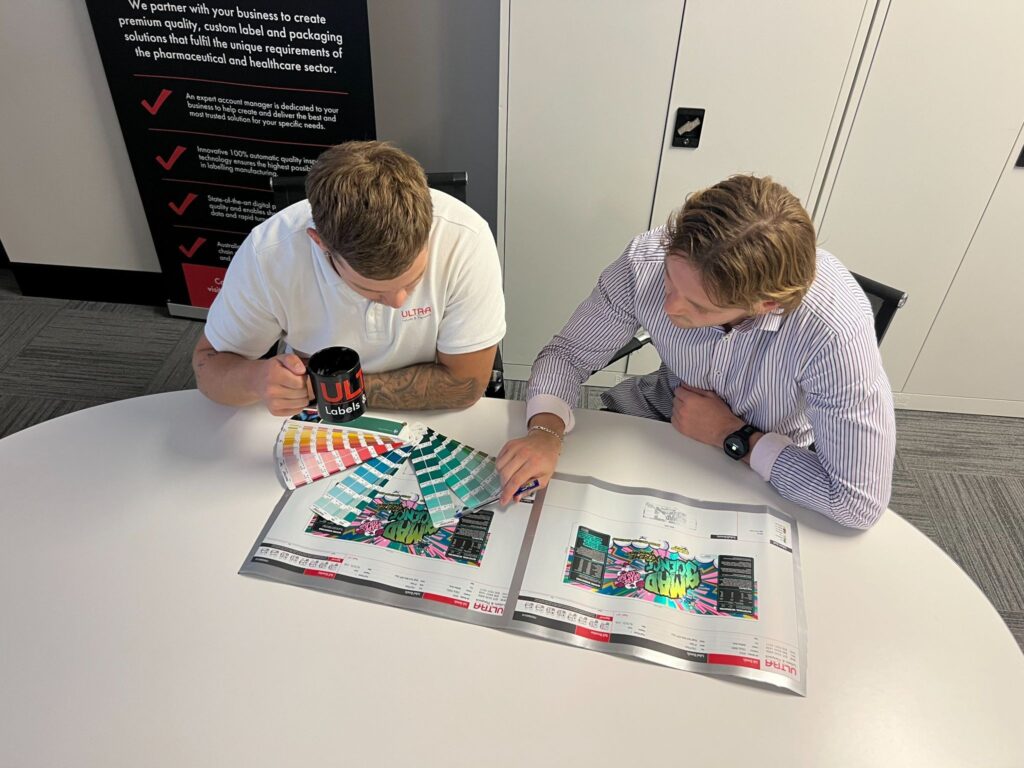
Ultra’s account managers therefore work on technical considerations alongside customers before production begins, while its in-house prepress team checks elements including colour, fonts, barcodes, QR codes and embellishments.
Proofing can also involve producing an actual sample on the press that will eventually manufacture the full order. For a company preparing a product launch or testing a new concept, that creates an opportunity to see the physical result before committing to volume production. A package has to communicate a brand visually, but it also has to work as a physical object.
Keeping Manufacturing Close to Home
While much Australian manufacturing has moved offshore over recent decades, Ultra has continued to produce its labels and flexible packaging domestically.
Local production gives the company greater oversight of lead times and manufacturing while reducing some of the exposure associated with long international supply chains. Ultra has continued investing in Australian production capacity as it has expanded, rather than separating growth from local manufacturing.
Environmental considerations have increasingly become part of that equation as well. Its manufacturing operates under ISO 14001 environmental management standards, while digital printing can help reduce some forms of production waste by allowing quantities to be more closely matched to what customers actually require.
The challenge for packaging manufacturers is that sustainability rarely comes down to a single material or technology. Waste, transportation, production volumes, substrates, product protection and end use all form part of the calculation.
Fifteen Years of Following the Same Idea
Ultra Labels & Flexpack looks considerably different from the Brisbane operation established in 2009.
It has expanded geographically, entered flexible packaging, added conventional printing alongside digital technology and developed specialist manufacturing capabilities for sectors including wine, food, healthcare and consumer products.
Yet the thinking behind its latest investment is closely connected to the idea that shaped the company at the beginning.
Brands rarely operate in perfectly predictable production cycles. Product ranges change. Volumes fluctuate. launches succeed or disappear. Artwork gets updated, retailers make new demands and businesses need to respond without necessarily knowing what their packaging requirements will look like several years from now.
Ultra’s trajectory has been built around manufacturing for that uncertainty.
The arrival of its newest digital press is another technological milestone, but the larger story is about what has happened to packaging itself. What began as an industry largely organised around producing large quantities efficiently is increasingly being asked to deliver scale and adaptability at the same time.
Ultra placed its first bet on that shift in 2009. More than 17 years later, it is still shaping the way the business thinks about what comes next.
To learn more about their services, visit ultralabels.com.au.