

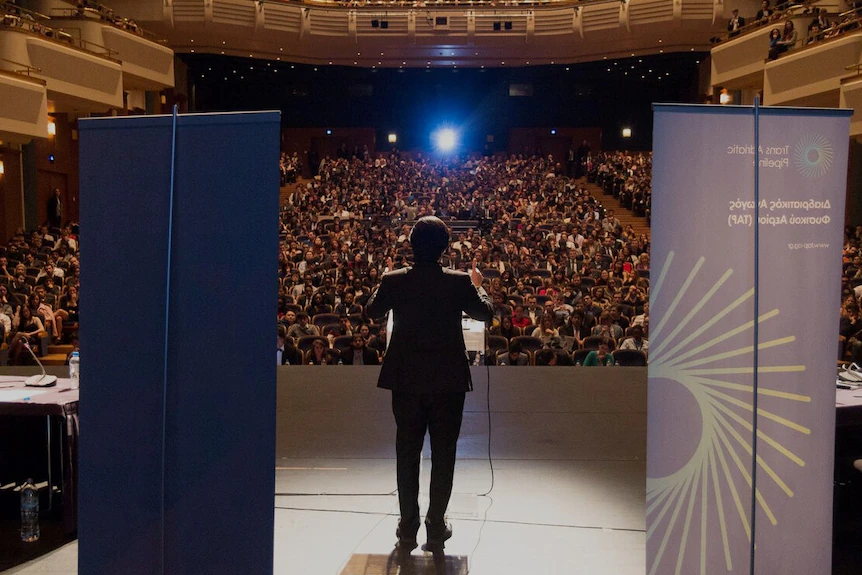
In the months after Bo Seo moved from South Korea to Australia at the age of eight, learning to agree with those around him wasn’t just an inclination — it became a survival mechanism.
He spoke no English, and an agreeable disposition felt like the easy option, even if it didn’t sit easily with the budding debater within.
“The hardest conversations to adjust to were disagreements — when people tend to talk over one another, and passions start to run and the rhythms of speech tend to break down,” he said.
“That made me resolve to be really very agreeable, to smile and keep most of my thoughts to myself.
“The thing that broke me out of that was my Year 5 teacher telling me that, in debating, when one person speaks, no-one else does — and to someone who had been spoken over and spun out of conversation and interrupted, that sounded like an irresistible promise.”
Through debating, Mr Seo discovered “a community that allowed me to be heard”.
He didn’t merely find his voice but used it to scale the highest rhetorical peaks and was part of the Harvard team that won the World Universities Debating Championship in 2016.
His prowess as a school debater took him across Australia, and he recently returned to Adelaide for a discussion of his book Good Arguments at UniSA’s Hawke Centre.
Disagreement doesn’t have to be disagreeable
The word ‘”debater” can conjure incongruous associations — on the one hand, there is the confident student politician, with rounded vowels and supercilious manner, dreaming of the parliamentary frontbench.
But that portrait is offset by another.
“If you kind of think about the kids who were debaters in school, you might remember there were some oddballs in there,” Mr Seo recently told ABC Radio Adelaide’s Deb Tribe.
“They learn to read a room, often as a matter of self-preservation.
“I’ve found, over the years, that in order to have a hope of persuading someone, you have to know where it is that they’re coming from, and that starts with listening.”
Good Arguments explores the consequences of that epiphany.
One of its insights is that the art of disagreement shouldn’t itself be disagreeable – debate and petty dispute aren’t different expressions of the same impulse, but deeply at odds.
The point is illustrated by the Monty Python sketch in which one character pays for an argument.
After opening exchanges of “yes I did” and “no you didn’t”, he becomes exasperated.
“An argument’s a collective series of statements to establish a definite proposition,” he tells his interlocutor.
“Contradiction is just the automatic gainsaying of anything the other person says.”


