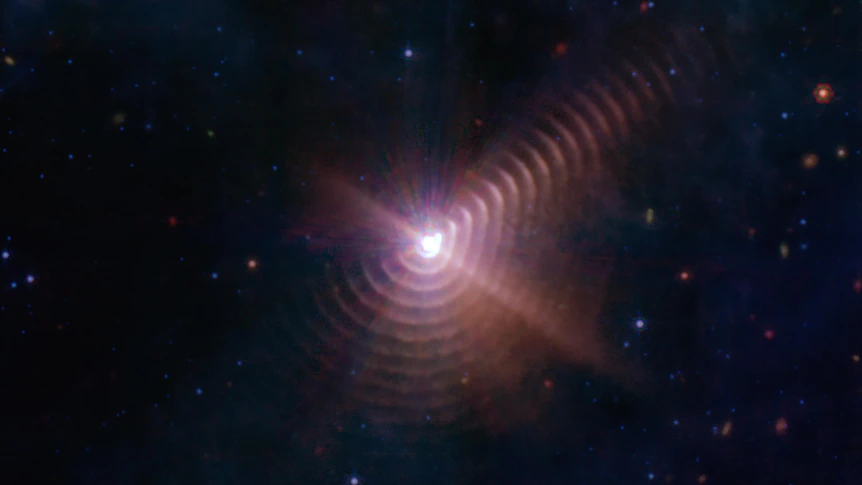
The internet lit up in late July when the first image of a pair of stars surrounded by ghostly dust shells was captured by the James Webb Space Telescope (JWST).
While some space enthusiasts threw around theories about alien megastructures, astronomers dug into the physics.
Now two new studies reveal the secrets of this eerily beautiful system, known as WR 140.
“When I first saw this image, I was like, ‘Oh, this can’t be real. We messed up,” said Ryan Lau of the National Science Foundation’s NOIRLab.
Dr Lau and his team had anticipated the stars would be surrounded by a single dust shell.
But the JWST observations, detailed today in the journal Nature Astronomy, revealed more than 17 shells nested inside each other.
“I was like, ‘Wow, it’s much better than we thought it was going to look like,'” he said.
The image also contained some mysterious shapes like the diagonal “spear” of light, which some astronomers thought was a telescope error, said another of the study’s co-authors, Peter Tuthill of the University of Sydney.
“If you said, ‘Is this a real or a fake web image?’ I think you could have surveyed professionals and you could have wrong-footed a lot of them with it,” he said.
But as luck would have it, Professor Tuthill’s student Yinuo Han had just developed a 3D model of WR 140 based on 20 years of data.
Their model, also published today in a separate paper in the journal Nature, explained how dust rings in the system were sculpted, and proved the features in the stunning image were not illusions.
WR 140 lies more than 5,000 light-years away in Cygnus, a prominent constellation in northern hemisphere skies.
At its heart is one of the cosmos’ most extreme type of stars — a Wolf-Rayet.
These massive stars are very rare — there are about one in a billion stars in our galaxy. They are extremely bright compared to other stars because they are on the verge of exploding.
“[Wolf-Rayets are] so luminous, they’re almost flying apart under their own luminosity,” Professor Tuthill said.
They also pump out a lot of radiation and blast winds that contain elements such as carbon, which can be detected by infrared telescopes like the JWST.
The fact that WR 140 pumps out dust at all makes it an enigma, said Professor Tuthill.
“Everything about this star screams, ‘I’m going to bake any dust into oblivion’.”
But Dr Han’s modelling, based on high-resolution infrared data from the Keck Telescope in Hawaii, revealed WR 140 had a couple of tricks up its sleeve.
So how are the dust shells created?
This Wolf-Rayet is locked in a violent tango with a hot, blue cosmic titan known as an O-type star.
But because its orbit isn’t circular, the Wolf-Rayet only puffs out dust every eight years when it is near the closest point to its stellar companion, the O-type star.