


- 96% of Australian employers who are leveraging AI and automation have experienced a return on their investment
- Employers experience increased productivity (47%), an improved employee experience (47%) and revenue growth (44%) from leveraging AI and automation
- 97% of employers require new hires to hold AI and automation proficiency but 88% of employers find it challenging to find talent with the right skills
- 98% of technology and finance departments and 88% of HR departments have taken on additional responsibilities as AI and automation shoulder more of the workload
Sydney, 13 October 2025 – Increased productivity is the most common return on investment from implementing artificial intelligence (AI) and automation for employers, who are now redirecting employees to take on higher-value and more strategic tasks.
New independent research by specialised recruiter Robert Half finds 96% of Australian employers have experienced at least one return on investment in AI and automation technologies in their organisations.
The biggest returns have been in:
- Productivity metrics (e.g., faster task completion, increased output) (47%)
- Employee experience (e.g., better engagement, reduced burnout) (47%)
- Revenue growth (e.g., improved customer targeting, higher sales conversion) (44%)
- Cost reductions (e.g., lower labour costs, fewer manual errors) (43%)
“AI is delivering returns beyond cost savings, with improved employee experience now standing alongside productivity as a key driver of ROI. Organisations are enabling employees to focus on more strategic, engaging work which is boosting both satisfaction and performance,” says Nicole Gorton, Director at Robert Half.
Almost all (97%) employers say they are looking to hire talent that hold AI and automation proficiency, although 88% of employers report it is challenging to find talent with the right AI and automation skills.
“Employers are very much aware of the transformative power of AI and automation, with most seeking these proficiencies. However, the challenges in finding the right talent are preventing companies to maximise their returns and take their business to the next level. Many businesses are still defining the skills they truly need, making it essential to clearly communicate expectations during the hiring process to attract the right candidates,” says Gorton.
The duties employees can focus on, thanks to AI and automation
As AI and automation take over tasks that employees were previously responsible for, employers are finding that they can focus more on other responsibilities.
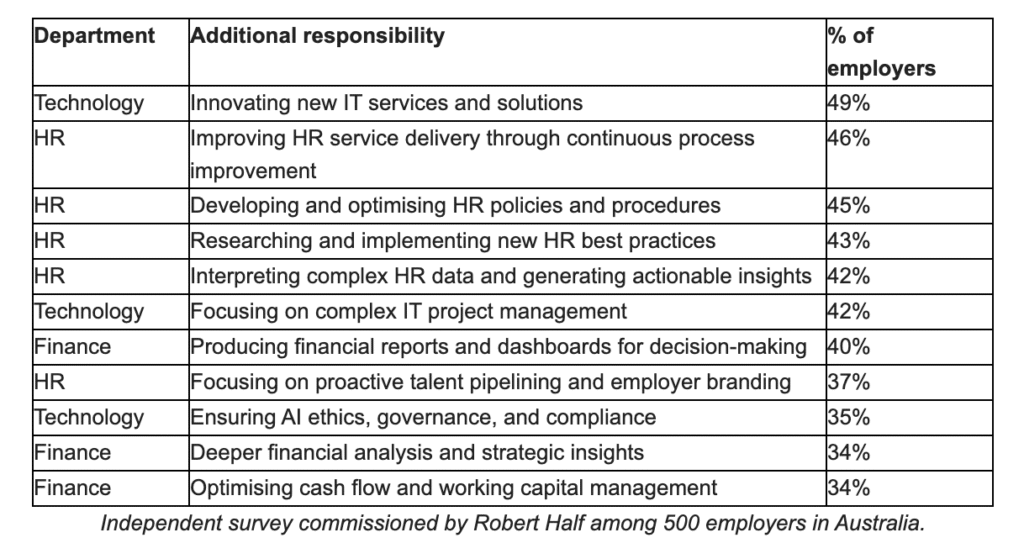
“AI and automation are gradually shaping the way roles develop and adapt. We’re seeing employers empowering their teams to focus on innovation and tactical process improvement. This is a move toward a more strategic, high-value-add workforce where human capital is focused on complex problem-solving and innovation with technology handling the routine tasks.”
“Across the board, the new responsibilities staff are taking on are clear signals of the emerging skills economy; skills that complement AI, not compete with it. We’re seeing a push toward critical thinking, ethical oversight and strategic analysis. For businesses, the focus is gradually shifting from purely technical expertise to candidates who can complement their tech skills with strategic thinking and the ability to leverage technology for broader organisational impact,” concludes Gorton.


