

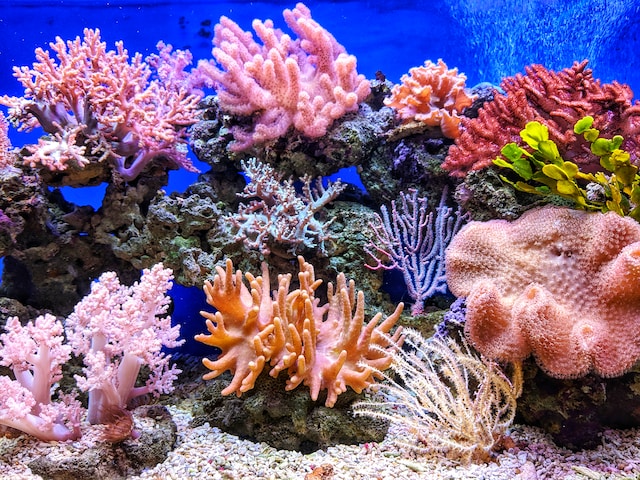
On a brisk winter’s day in Sydney, most people find the seawater temperature near freezing. But for coral, it’s far too warm.
Rising water temperatures continue to threaten coral populations around the world, with a top United States science body recording ocean temperatures at an all-time high.
Experts warn the future for coral ecosystems is bleak.
Senior research fellow Selina Ward from the University of Queensland said an increase by just one degree above maximum summer temperatures can be enough to cause damage.
“If it’s only one degree, it then might take three months to have a bleaching event, if we’ve got a two-degree, or three-degree maximum it might be as little as four weeks,” she said.
And the consequences of losing coral reefs aren’t just devastating for marine life, Dr Ward warned.
“If we look at Australia, there’s about 65,000 jobs associated with the Great Barrier Reef, but if we look at the world, there are millions of people who feed on coral reefs.
“Reefs protect island nations from swell, so without them, those island nations are at risk if we add increased intensity of cyclones and storm activity, some sea level rise, you can see that these problems are really very severe.”
Ground-breaking research
A team of Sydney scientists are getting creative about how to provide these underwater gardens with the best chance of survival against global warming, starting with coral found in Sydney Harbour.
With a passion for coral conservation, Jen Matthews is leading the ground-breaking research, after she was awarded a Biodiversity Fellowship by the University of Technology Sydney.
Half-way through a three-year research project, Dr Matthews and her students are hoping that tweaking what corals eat to include more fat, will help to shield them from heat stress.
“Just like every organism, corals require an optimal nutrition to grow, reproduce and survive diseases and environmental changes,” Dr Matthews said.
“But we actually know very little about what is an optimal nutrition for corals.”
With the help of her students, native and invasive coral was collected from Cobblers Bay and off the Manly heads to be dissected and tested under different heat conditions in controlled aquariums at the Sydney Institute of Marine Science laboratories.
The specimens are then biopsied before scientists use DNA genotyping and lipidomics to understand a coral’s ideal nutrition when faced with thermal stress.
Using these findings, researchers will give corals what a nutritional supplement is to humans, but instead of vitamin C, it’s fat.
“Essentially, you can feed these little fat balls to the coral, and they take them, and they eat them”, Dr Matthews said.
“Corals are like jellyfish, they’re related to jellyfish but just upside down. They have tentacles that surround their mouth in the middle, so you can actually feed them with tiny little particles.”


