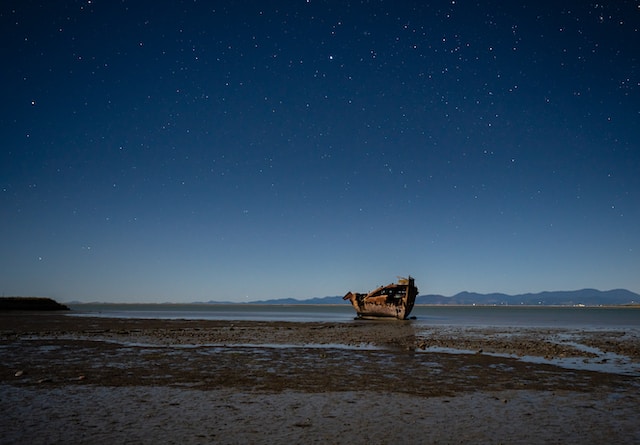
The crew of the MV Blythe Star had no reason to suspect the 44-metre freighter would join the hundreds of other ships that had disappeared into the depths off Australia’s treacherous south-east coast.
It was a fine day, just under 50 years ago, and the water was calm. Then the Blythe Star suddenly listed to starboard and keeled over just off Tasmania’s south-west cape.
The 10 crew members made it onto an inflatable raft.
But after nine days on the raft and a subsequent three-day, cross-country trek, only seven survived.
The resting place of the Blythe Star itself remained a mystery until this year — when the cargo ship was found 10 kilometres off Tasmania’s south-west coast.
Maritime archaeologists had a hunch about its location; then the CSIRO’s Research Vessel (RV) Investigator, en route to study an underwater landslide, confirmed its location.
There are 660 documented shipwrecks along the Victorian coastline, but fewer than half have been found and identified.
The successful rediscovery of the MV Blythe Star has given Victorian archaeologists and historians renewed hope for the more than 300 vessels that remain lost.
Heritage Victoria senior maritime archaeologist Danielle Wilkinson said historic records proved the ships existed, albeit hidden in the depths.
But the Investigator’s suite of scientific wizardry allows historians to find those in the deepest waters.
“Beforehand most of our discoveries were undertaken by divers, and that’s limited by depth,” Ms Wilkinson said.
“Recreational diving lets you dive to about 30 metres, technical diving to 70 to 80m. Any deeper and you are getting to the limit of what’s safe.
“The Investigator can search — using technology — much, much deeper environments … where divers cannot safely access.
“That’s why they were able to find one of our shipwrecks, the SS Iron Crown, in 700m of water in Bass Strait.”